|
A Holistic Approach to Dog Training (Parts 1 & 2) |
Dog Training is about much more than you training the dog
By Don Hanson, BFRAP, CDBC, CPDT-KA
[This article was originally published in two parts in the January 2015 and February 2015 editions of the Downeast Dog News.]
It was forty years ago this month, when I had just turned 17 that my parents finally agreed to let me have a dog. I brought home a little black fluff of fur with no real idea of what to do other than to love and feed her. Neither the pet store where I bought Trivia, nor the veterinarian who examined her, suggested she have any level of training; in fact they didn’t even mention housetraining. Nor did they suggest I learn anything about what it’s like to be a dog.
 Somehow Trivia and I survived, but as I look back I know that the relationship we had and Trivia’s quality of life Somehow Trivia and I survived, but as I look back I know that the relationship we had and Trivia’s quality of life
|
|
Read more...
|
|
It’s Responsible Pet Owners Month…Time to Train Your Dog |
|
[This article first appeared in The Maine Edge on January 28, 2015]
 If you are like most people, you got a dog for companionship. Companions hang out together and training your dog makes that easier. February is Responsible Pet Owners month, and one of the most conscientious things any dog owner can do is to take the time to appropriately train their dog. Odds are if you train your dog they will be able to do more with you and will be welcome more places you would like to take them. Even your friends and family that don’t like dogs, and yes those people exist, will perhaps at least tolerate your well trained, well behaved, magnificent dog. If you are like most people, you got a dog for companionship. Companions hang out together and training your dog makes that easier. February is Responsible Pet Owners month, and one of the most conscientious things any dog owner can do is to take the time to appropriately train their dog. Odds are if you train your dog they will be able to do more with you and will be welcome more places you would like to take them. Even your friends and family that don’t like dogs, and yes those people exist, will perhaps at least tolerate your well trained, well behaved, magnificent dog.
An untrained dog is likely to result in you, and possibly other family |
|
Read more...
|
|
What Is Clicker Training? |
|
 Clicker Training uses an event marker or signal paired with positive reinforcement to train the dog each desired individual behavior. The reinforcement may be food, play, or even freedom; whatever is most motivating to the dog and applicable for that specific training session. The marker signal, in this case a “click”, is used to precisely indicate the instant the dog performs the desired behavior. For example, if I'm training a dog to sit, I click at the exact instant the dogs butt touches the floor and then reward them with a small treat. There is nothing magic about the clicker it is just a signal. Marine mammal trainers typically use a whistle as their signal or event marker. The clicker is used as a training tool only, and once the dog has been trained the behavior the clicker is no longer used for that behavior. Clicker Training uses an event marker or signal paired with positive reinforcement to train the dog each desired individual behavior. The reinforcement may be food, play, or even freedom; whatever is most motivating to the dog and applicable for that specific training session. The marker signal, in this case a “click”, is used to precisely indicate the instant the dog performs the desired behavior. For example, if I'm training a dog to sit, I click at the exact instant the dogs butt touches the floor and then reward them with a small treat. There is nothing magic about the clicker it is just a signal. Marine mammal trainers typically use a whistle as their signal or event marker. The clicker is used as a training tool only, and once the dog has been trained the behavior the clicker is no longer used for that behavior.
Clicker Training is not a |
|
Read more...
|
|
Socialization & Habituation |
|
OBJECTIVE: To habituate your puppy/dog to the many different types of people, places, dogs, animals and things in the world, so they are not afraid of these things.
Actively and wisely socializing a puppy between 8 and 16 weeks of age is as critical to a puppy’s behavioral health as vaccinations are to their physical health. Click here to listen to a eight minute podcast where Dr. David Cloutier and Don Hanson discuss this critical issue.
I cannot stress enough the importance of socialization at this juncture in your puppy’s life. Dogs have a critical socialization period, which typically occurs between 8 and 16 weeks, allowing room for some individual variability. It is during this |
|
Read more...
|
|
OBJECTIVE: To teach your dog that it is safe to be left alone.
Dogs are social animals and actively seek out our companionship. They can quickly become accustomed to being part of a group 24 hours a day, seven days a week. Whenever a new dog is brought into a home, especially a young playful puppy, people have a tendency to interact with them constantly. While this interaction is a very important part of socialization and bonding, you need to make sure that you are not setting your puppy up for a big disappointment when you must leave him at home alone. Including some “alone training” right from the beginning will be beneficial to both your puppy and you.
Older dogs, depending on their previous circumstances, might also need to learn how to cope with being alone. For example, a dog that was housed in a |
|
Read more...
|
|
The Unintended Consequences of Shock Collars |
|
Green Acres discourages the use of shock collars on pets for containment, training via positive punishment or negative reinforcement, or management of barking because they; 1) cause pain and stress, 2) they can cause aggression and 3) because there are alternative humane methods to training and containment. Shock collars are banned in many countries because of concerns for animal welfare. We share those concerns.
On March 29, 2014 Don and Kate discussed this topic on The Woof Meow Show. You can listen to that show by clicking here.
What Is A Shock Collar?
A shock |
|
Read more...
|
|
Halloween Tips for Pets and Their People |
|
 Halloween is that time of year when children and even some adults like to dress up in fun costumes that make them look different and often scary. People may even take on the stilted walk or the pseudo-terrifying vocalizations of the character they are pretending to be. Halloween is that time of year when children and even some adults like to dress up in fun costumes that make them look different and often scary. People may even take on the stilted walk or the pseudo-terrifying vocalizations of the character they are pretending to be.
Now think about Halloween and all of the shenanigans it entails from your pet’s perspective. Was your dog ever habituated to anything remotely like Halloween? Is it likely that they will find groups of people behaving weirdly and trying to scare one another a pleasant experience? You already know that for most pets, the answer to both questions is a resounding “No!” Do your pets a favor this Halloween and keep |
|
Read more...
|
|
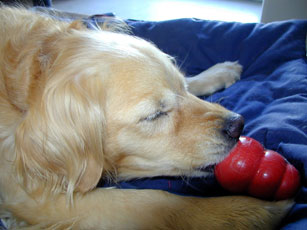
Available as a podcast at: http://traffic.libsyn.com/woofmeowshow/WoofMeowShow-2013-01-12-TYDM_Playbiting_Chewing.mp3
OBJECTIVE: To learn how to manage your dogs chewing behavior.
While a puppy may chew more during the teething stage, chewing is a very normal behavior for dogs of all ages. They do it out of pleasure; they do it to pass the time; they do it to relieve stress and they do it to exercise their jaws and teeth. We need to allow our puppies and dogs to have an outlet for |
|
Read more...
|
|
Biting and Bite Thresholds |
|
Available as a podcast at: http://traffic.libsyn.com/woofmeowshow/WoofMeowShow-2013-01-12-TYDM_Playbiting_Chewing.mp3
OBJECTIVE: To teach your dog to have a gentle bite that does not hurt, if he ever makes mouth contact with you or any other person.
No matter how much training you do and how gentle your dog is, under certain circumstances any dog can be provoked to bite. Biting is an act of defense for a dog; it is often an instinctual response to specific situations |
|
Read more...
|
|
Dogs, Summer and Behavioral Issues |
|
This article first appeared in the June 2015 edition of the Downeast Dog News.
Summer, a time of year that most of us look forward to and a common time for people to get a new puppy, a new dog, to go to or host family gatherings, and to deal with the fireworks. All of these things can have positive and negative effects on our dog's behavior, depending on how we handle them. These are some tips you can use to make the most of your summer for you and your dog.
|
|
Read more...
|
|
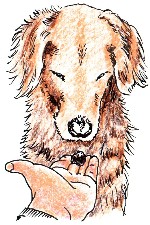 OBJECTIVE: To teach your dog to take things from your hand when cued to do so and leave things in your hand or elsewhere when cued to do so. OBJECTIVE: To teach your dog to take things from your hand when cued to do so and leave things in your hand or elsewhere when cued to do so.
The Take It and Leave It cues are useful when you want to tell your dog he may take a treat or toy and when you want to tell him NOT to take a treat, toy, piece of garbage, the cat, or some other object he is not supposed to have. We teach this in the following manner:
|
|
Read more...
|
|
Attention (Look - Watch Me) |
|
ATTENTION (Look)
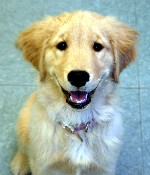 OBJECTIVE: To teach your dog to look at you when given a single visual or verbal cue and that it is safe and rewarding to do so. Remember, for most dogs, direct eye contact is confrontational and something to be avoided so if your dog appears to be reluctant to make eye contact have patience while introducing this behavior. OBJECTIVE: To teach your dog to look at you when given a single visual or verbal cue and that it is safe and rewarding to do so. Remember, for most dogs, direct eye contact is confrontational and something to be avoided so if your dog appears to be reluctant to make eye contact have patience while introducing this behavior.
We teach the ATTENTION behavior because a dog that pays close attention to you and will make direct eye contact is a dog that will be easier to train. This exercise serves two very useful purposes: 1.) It trains your dog to focus on you, and 2.) It trains you to focus on your dog.
The best way to establish a solid foundation for the ATTENTION behavior is with the hand-feeding program outlined below. The more distractible your |
|
Read more...
|
|
OBJECTIVE: To teach your dog to lie down on a single verbal or visual cue in a relaxed position, wherever they are, and to remain there until given another cue.
|
|
Read more...
|
|
OBJECTIVE: To teach your dog to get into a SIT position, wherever they are, when given a single visual or verbal cue and to remain in position until released or given another cue.
|
|
Read more...
|
|
Accepting the Pet You Have ... |
|
"Accept the dog you have, not the one you wish you had.” This quote, from a presentation entitled: Relationship: The heart of positive reinforcement training, by Leslie Nelson of Tails-U-Win! Canine Center in Manchester, CT, was for me, the highlight of 2005 Association of Pet Dog Trainers educational conference. In twelve words, Leslie summed up the essential ingredient to having a happy relationship with your dog.
|
|
Read more...
|
|
 Canine Life and Social Skills (C.L.A.S.S.) is a new program developed by the Association of Pet Dog Trainers (APDT) based on input from both dog owners and non-dog owners, shelter workers, and professional dog trainers. C.L.A.S.S. has been designed in an effort to benefit not just pet owners and dogs, but the community as a whole! Canine Life and Social Skills (C.L.A.S.S.) is a new program developed by the Association of Pet Dog Trainers (APDT) based on input from both dog owners and non-dog owners, shelter workers, and professional dog trainers. C.L.A.S.S. has been designed in an effort to benefit not just pet owners and dogs, but the community as a whole!
C.L.A.S.S. has some similarities to the AKC Good Citizen Test or therapy dog testing, but in many ways it is also very different. It is a three-level evaluation in which dog guardians can demonstrate the real-life skills of their dogs, as well as demonstrate their own understanding of basic dog handling, training and care. There are three levels to C.L.A.S.S. (B.A., M.A., and Ph.D.), each requiring a higher level of training
The APDT developed C.L.A.S.S. with |
|
Read more...
|
|
Biting and Bite Thresholds |
|
The objective of BITE INHIBITION is to teach your dog to have a gentle bite that does not hurt, if he ever makes mouth contact with you or any other person.
Punishing the dog for biting and teaching “No Bite” just suppresses behavior, while teaching bite inhibition teaches what we want. Suppressed behaviors often return in a violent manner.
No matter how much training you do and how gentle your dog is, under certain circumstances any dog can be provoked to bite. Biting is an act of defense for a dog; it is a very instinctual response. There are a variety of reasons that a dog may bite and contrary to popular belief, few bites are committed by “aggressive” dogs. Humans have really done a great disservice |
|
Read more...
|
Understanding Our Animals Needs
A significant cause of stress for an animal occurs when its most basic needs are not being met. One of the first and most comprehensive efforts to define an animal’s most basic welfare needs started in Great Britain in 1965 with the establishment of the Brambell Commission. This commission, created by Parliament, was charged with reviewing the treatment of farm animals and developing a minimum standard for meeting their needs. They created what is known as “The Five Freedoms,” which is an excellent starting point for evaluating the welfare of any animal, including pets. The five freedoms are: |
|
Read more...
|
|
Assessing Pets’ Welfare Using Brambell’s Five Freedoms |
By Don Hanson, ACCBC, BFRAP, CDBC, CPDT-KA
(This article was first published in the Fall 2014 issue of the Association of Professional Dog Trainers Chronicle of the Dog - [Click for a PDF of this article])
As trainers and behavior consultants, it is essential for us to consider whether or not a pet’s basic needs are being met if we are to offer our clients the best possible training and behavioral advice. This becomes even more important when facilitating the treatment of “problem behaviors,” as these often manifest when a pet’s welfare is compromised or when basic needs are not being met consistently. Brambell’s Five Freedoms are a very useful set of |
|
Read more...
|
|
Canine Calming Signals and Stress |
|
The “Woof-Meow” show is on every Sunday at 8:30PM on WVOM, 103.9FM, the Voice of Maine. Hosted by Don Hanson of Green Acres Kennel Shop, the show focuses on educating dog and cat guardians about their dogs and cats.
AIR DATE: Sunday, March 12th and 19th, 2006
GUESTS: Kate Dutra and Becky Robinson |
|
Read more...
|
|

OBJECTIVE: To learn how to manage your dogs chewing behavior.
While a puppy may chew more during the teething stage, chewing is a very normal behavior for dogs of all ages. They do it out of pleasure; they do it to pass the time; they do it to relieve stress and they do it to exercise their jaws and teeth. We need to allow our puppies and dogs to have an outlet for natural behaviors such as chewing. It is our responsibility to provide them with things that they can chew on and to help them learn that they are only to chew on their specified chew toys.
|
|
Read more...
|
|
Clicker Training - A Dog's Point of View |
|
I groaned in disgust when my mom came home and announced I would be attending an obedience class. Wasn't she aware that I already knew everything? Why was this insane woman putting me through these nonsensical commands all over again? She even seemed convinced that this "new style" of training was going to be fun! UGHHHHH…Oh well, I realized that mom was determined. At my age, I was going back to school. |
|
Read more...
|
|
The Definition of Dog Training |
|
How would you define “dog training?” This is a question we always ask our incoming students. People have many preconceived ideas about what it takes to train a dog. The old traditional approaches to dog training say you have to show the dog “who’s boss.” This is just not true and in fact, is counterproductive to training and the relationship you have with your dog.
At Green Acres we view you and your dog as a team and encourage you to do likewise. Training your dog is not about “you against your dog,” it is about "you with your dog." By working as a team you will both be more successful and have more fun. |
|
Read more...
|
|
Doggie Kissing Booths - Good Idea or Unkind to Dogs? |
|
The concept of a “kissing booth” as a fundraising attraction at a carnival or some other event is not new. However, doggy kissing booths, where a person pays to give a kiss or hug to a dog or to get a kiss from a dog, is a relatively new trend. As a dog lover and Certified Dog Behavior Consultant, I find the idea of a doggy kissing booth very disturbing. When I privately shared this concern with a group organizing a fundraising event for a local dog park, the leader of the group publically labeled me a “jerk” on the groups Facebook page. If caring for the wellbeing and safety of dogs and people makes me a “jerk,” then I will gladly wear that badge with honor.
|
|
Read more...
|
|
Dominance: Reality or Myth |
|
<Print PDF of this article>
<listen to a podcast on this topic>
It was in the September of 2000 that the first version of this article appeared in
Read more...
|
|
I have heard that some dogs like Poodles and Bichon Frises do not shed. Is this true?
While some dog breeds shed more heavily than others, all dogs, with the exception of hairless breeds, shed. Often people obtain Labrador Retrievers, believing that since their coats are short they will not shed very much. The fact is that Labs often shed quite a lot and have a tendency to do so year round. The northern breeds such as Huskies and Malamutes, while they shed year round, have a major coat blow in the Spring which usually lasts a couple of weeks to a month. Poodles and similar coated dogs do not tend to shed as much as the other breeds because they do not have a double coat. Poodle shedding is often deceptive; when they shed their hair it does not end up on the floor. Instead it remains in their coats and contributes to the creation of mats if not properly brushed. |
|
Read more...
|
|
Growling - What Should I Do When My Dog Growls? |
|
While a dog’s growl can be upsetting and disheartening to us it also serves the very useful purpose of alerting us to the fact that the dog is feeling threatened or uncomfortable. It is the dog’s way of saying “If something in this situation does not change, I may feel threatened enough to bite.”
As a certified dog behavior consultant (CDBC) I deal with a greater number of aggressive dogs than the average person, I love it when a client dog growls. When a dog growls at me it is giving me a warning and an opportunity to change my behavior, thus preventing a bite from occurring. For this reason, I advise all my clients and students that it is NEVER wise to punish a dog for growling, even by saying “No.” Dogs that are repeatedly punished for growling eventually may not give a warning and immediately escalate to biting. A dog that does not growl before biting is a dangerous dog.
|
|
Read more...
|
|
Help! My Puppy's a Land Shark! |
|
I recently received the following email from a prospective client. Since the problem they are experiencing is often typical, I thought I’d share their questions and my response. |
|
Read more...
|
|
(If reading is not your thing – checkout our podcast on housetraining at (http://traffic.libsyn.com/woofmeowshow/WoofMeowShow-2013-01-05-TYDM_Housetraining.mp3)
Training your puppy or dog not to urinate or defecate in your house should begin as soon as you bring them into your home.
The same process used to housetrain a puppy can also be used with an older dog that is not housetrained or that develops housetraining issues. If you have an older dog that you thought was previously housetrained but is now having issues, the first thing you should do is make an appointment with your veterinarian. It is highly likely that your dog’s |
|
Read more...
|
|
I knew of Marian and Bob Bailey but had never heard them speak until the Association of Pet Dog Trainers (APDT) Conference in Valley Forge. After spending an hour with them and their chickens, I realized there was a great deal that the Bailey's could teach me. I knew they were having a 5-Day workshop in the summer, and like an eager retriever waiting for dinner, could not wait to signup. |
|
Read more...
|
|
|